
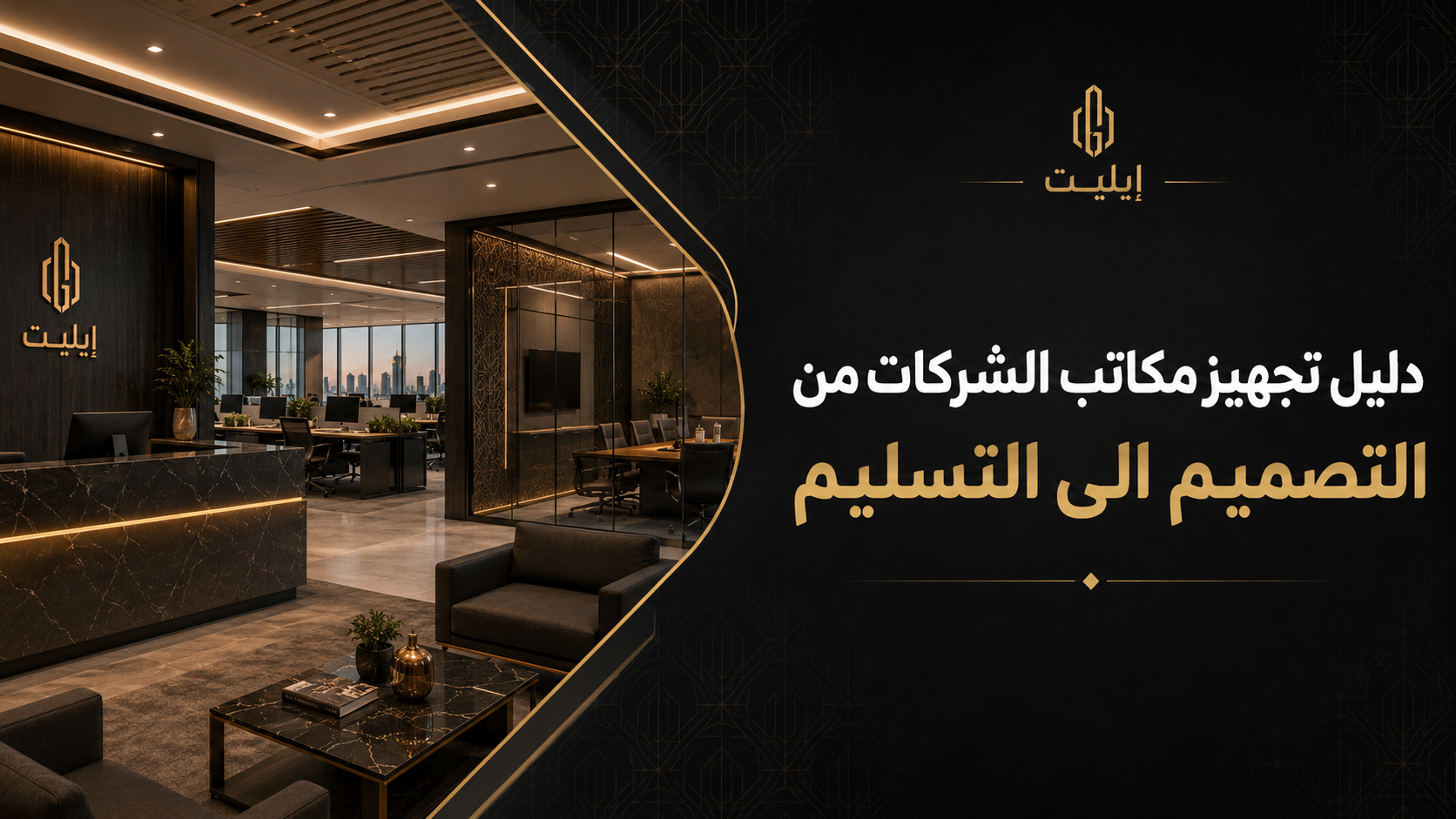
Government Office Furniture: Specifications, Tenders and Local Content
Short answer: Furnishing government offices requires precise specifications and a clear bill of quantities, compliance with the Government Tenders and Procurement Law, Etimad platform and local content requirements, and durable furniture that serves for years under heavy use. Elite Premier manufactures office furniture locally in Jeddah and delivers government projects from design to installation.
Furnishing government offices differs from furnishing private-sector offices in many ways. Purchasing usually goes through tenders and formal procedures, specifications must be clear and comparable across bidders, and furniture is expected to serve for many years with large numbers of staff and visitors. In this guide we explain how to furnish government offices properly, how to write precise specifications and what to consider in tenders, whether you are an official in a government entity or a supplier preparing to bid.
Important: this article is general guidance. Laws, regulations and mandatory lists may be updated, so always refer to the terms and specifications booklet of each tender, the Etimad platform and the Local Content and Government Procurement Authority for current requirements.
The regulatory framework for government procurement
Government purchasing in Saudi Arabia is governed by the Government Tenders and Procurement Law and its implementing regulations, which set out purchasing methods, preparation of terms and specifications, bid evaluation, award and contract execution. Most tenders are issued electronically through the Etimad platform, where registered suppliers can view tenders, buy booklets and submit bids.
The Local Content and Government Procurement Authority also plays an important role in promoting local content in procurement, and some tenders may include requirements or preference for national products or mandatory lists of local products. This makes local furniture manufacturing a clear advantage for both entities and suppliers.
What makes government office furniture different?
- Longevity: government furniture is typically used for many years, so durability comes before fashion.
- Intensive use: visitor service and reception areas see heavy daily use.
- Standardisation: large entities need consistent specifications across departments and branches.
- Regulatory clarity: every item must be described precisely to allow fair comparison.
- Security and confidentiality: some departments need lockable storage and secure archiving.
See our dedicated service: government office furniture.
Main components of a government furniture project
Officials’ and senior management offices
Executive offices that reflect the entity’s standing without excess, with back storage, a small meeting table and guest seating, ideally in a consistent design language. See executive office furniture.
Staff workstations
Durable workstations sized to the work, with cable management and screens for privacy. See office workstations.
Visitor service halls
Multiple service counters and enough waiting seats for peak times, accessible for people with disabilities and the elderly. See reception desks.
Meeting and training rooms
Formal meeting rooms with presentation and video-conferencing provision, plus flexible training rooms. Read training and conference room furniture.
Archives and storage
Archive rooms with high-density shelving and lockable cabinets for sensitive documents. See office storage and filing.
How to write precise furniture specifications for a tender
Vague specifications are one of the biggest sources of problems in government furniture projects: they allow unequal bids, and disputes surface at delivery. Good specifications define required performance and quality without being tailored to a single product or supplier.
Elements of a good specification for each item
- Key dimensions with an acceptable tolerance.
- Material type, thickness and density for tops and frames.
- Edge type and finishing method.
- Hardware such as hinges, runners and locks.
- Colours or an acceptable colour range.
- Performance requirements such as load and stability, with reference standards where relevant.
- Warranty length and scope and after-sales service.
- Supply, installation, delivery location and schedule.
A clear bill of quantities
Each item needs a number, description, unit and quantity, with furniture separated from installation and transport where needed. A clear bill makes bid comparison fair and reduces queries and variations.
Samples and mock-ups
On large projects, require samples of key items such as chairs and workstations before full supply, or a mock-up of a room or office area. This exposes differences between what was described and what will actually be supplied, and reduces rejected deliveries and disputes over compliance.
Reference standards
Entities can reference recognised furniture testing standards for durability and safety, as long as they suit the project and do not restrict competition to one supplier without justification. Test reports or conformity certificates for key materials can also be requested where needed.
Bid evaluation criteria
Evaluating furniture bids should not rest on the lowest price alone, especially where furniture will serve for many years. Booklets usually consider both technical and financial elements, and technical criteria can include:
- Compliance with the technical specification of each item.
- Quality of submitted samples.
- Previous experience on projects of similar size and sector.
- Production capacity and the proposed schedule.
- Installation plan and team.
- Warranty length, after-sales service and spare-parts availability.
- Local content share where requirements apply.
For suppliers, reading the booklet carefully and submitting queries within the set deadlines is essential, because misreading a specification can lead to exclusion or problems at delivery.
Why local manufacturing matters in government projects
- Shorter lead times than full importing, with lower shipping risk.
- Control over dimensions to fit different government building plans.
- Easier maintenance and spare parts over years of use.
- Consistent specifications when expanding or equipping new branches.
- Support for the national economy in line with Vision 2030.
At Elite Premier we manufacture in our Jeddah factory, which lets us produce samples quickly, keep precise dimensions and provide direct after-sales service.
Planning the project timeline
Government projects are usually tied to specific opening or relocation dates, and delay at any stage affects the whole schedule. Split the project into clear stages:
- Needs study: staff, departments and spaces.
- Design and layout: an initial plan that fixes quantities accurately.
- Booklet preparation: specifications, bill of quantities and conditions.
- Tender and evaluation: through Etimad under the regulatory procedures.
- Sample approval: before volume manufacturing.
- Manufacturing and supply: on a schedule tied to building readiness.
- Installation and handover: using a clear inspection checklist.
A common mistake is tendering furniture before the building’s final layout is settled, so quantities have to change after award. To calculate quantities properly read how much office space per employee.
Designing visitor service halls
The visitor service hall is the face of a government entity to citizens and residents, and its design directly shapes the service experience. Key elements:
- Clear service counters with numbers or signage and a lowered section for wheelchair users.
- Comfortable waiting seats for peak times, with separate areas where needed.
- Clear circulation from entrance to waiting, counter and exit.
- Appropriate privacy for transactions involving personal data.
- High durability for surfaces and seats used by hundreds of people daily.
Low screens between counters give visitors some privacy without isolating them, and calm colours and good lighting reduce stress while waiting.
Corporate identity in government offices
Many government entities have developed modern visual identities in recent years, and the workplace should reflect them. This can be done without much extra cost: identity colours in upholstery and finishes, the logo on the reception counter or entrance wall, and identity-inspired patterns on glass partitions. These elements should be consistent across departments and branches and clearly specified so suppliers comply.
Sustainability in government procurement
Sustainability criteria are increasingly important and can be built into specifications practically: low-emission materials, modular furniture that can be reconfigured instead of replaced, designs that are easy to maintain and repair, and less packaging and waste in supply. These criteria do not necessarily raise cost and can reduce it over time because furniture lasts longer. See sustainable office furniture.
Choosing materials
| Material | Suitable use | Notes |
|---|---|---|
| High-density melamine | Staff workstations and cabinets | Scratch-resistant, economical, easy to maintain |
| High-pressure laminate (HPL) | Heavy-use tops and counters | Higher resistance to wear and impact |
| Natural wood veneer | Officials’ offices and formal rooms | Premium look, needs more care |
| Powder-coated steel | Frames, legs and metal cabinets | Strength, stability and long life |
| Corian or engineered stone | Visitor service counters | Very resistant and easy to clean |
| Fabric or faux leather | Chairs and waiting seating | Chosen by usage intensity and ease of cleaning |
Avoid weak materials on heavily used items, because early savings can turn into early replacement costs. See the materials guide.
Formal meeting rooms and video conferencing
Government meeting rooms host formal meetings with other entities and delegations, as well as video meetings that are now a core part of work. They need tables of the right size with built-in power and data boxes, hidden cable routes, a dedicated screen wall away from windows, comfortable chairs for long meetings and a layout that keeps every participant on camera. Large rooms with hard surfaces also need acoustic treatment, because echo affects the clarity of video meetings. Coordinate early between the furniture supplier and the audio-visual supplier so tables are designed with openings and routes for the selected equipment.
Standardising furniture across departments and branches
Entities with branches in several cities benefit greatly from a unified furniture guide that defines approved workstations, chairs, cabinets and colours. It simplifies future tenders, ensures a consistent identity, reduces the time needed to write specifications for each new project and makes bids easy to compare because items are fixed and known.
Installing in occupied buildings
Many government furniture projects are carried out in buildings where staff are already working, which requires a phased installation plan that does not interrupt service: dividing the building into zones, temporarily relocating staff, working out of hours when needed and removing old furniture in an organised way.
Safety and accessibility
Government office furniture must respect safety requirements, the Saudi Building Code and Civil Defense, especially along escape routes, in corridor widths and in fixing tall cabinets. It must also provide access for people with disabilities at service counters, waiting halls and meeting rooms, an area receiving growing attention in public-facing entities.
Accurate quantities before tendering
A common cause of post-award variations is estimating quantities without a detailed plan. The difference between current and expected headcount, the number of enclosed offices, waiting seats and cabinet lengths all affect the bill of quantities. The most accurate method is to prepare a layout for each floor first and extract quantities directly from it, adding a limited, justified contingency for items expected to grow. Numbering items on the plan with the same numbers as the bill of quantities helps installers place each piece and helps the acceptance committee check quantities and locations.
The acceptance committee and inspection checklist
Handover in government projects is a formal procedure and needs a clear checklist used on every floor and zone: matching quantities and locations, checking dimensions and finishes, operating drawers and locks, confirming tall cabinets are fixed, testing chairs and adjustments, then recording each snag with an owner and a close-out date. This protects both entity and supplier and ensures no open items remain after final handover.
Warranty and maintenance after handover
Warranty in government projects should be defined precisely: length, coverage of manufacturing defects, hardware, gas lifts and castors, response time for maintenance requests and how spare parts are supplied. Entities that specify these in the booklet get clearer service and fewer disputes later.
New buildings vs. refurbishment
A furniture project in a new government building differs from refurbishing occupied premises. In a new building the layout can be planned from scratch and furniture linked to power, data and air-conditioning from the architectural design stage, but the schedule is usually tied to a fixed opening date that cannot slip. In refurbishment the main challenge is keeping services running during works, dealing with existing constraints such as columns and power outlets, and deciding what existing furniture can be reused. In both cases, involving the furniture supplier early with the entity’s engineering team saves time, because many installation problems, such as desks clashing with floor boxes or large pieces that will not fit through corridors and lifts, can be avoided with a simple review at the planning stage.
Reusing existing furniture
Not all old furniture must be replaced. In refurbishments, existing furniture can be surveyed and classified into items usable as they are, items needing repair or reupholstery, and items to replace. This survey can noticeably reduce the budget and supports sustainability and waste reduction, provided reused pieces fit the new identity.
Communication during delivery
Success depends on clear communication as well as good specifications and furniture. Appoint a single representative to approve technical decisions, hold short regular progress meetings on manufacturing and supply, and keep a written log of any change to quantities or locations. These simple practices prevent conflicting instructions from different departments, protect the schedule and make final acceptance faster and clearer for both sides.
Tips for suppliers bidding on tenders
- Keep your Etimad registration and documents complete and up to date.
- Read the booklet carefully, especially the technical specification, bill of quantities and special conditions.
- Submit queries on unclear items before the deadline.
- Comply rather than improvise; present alternatives separately if permitted.
- Propose a realistic schedule based on actual capacity.
- Submit samples that match what you will actually supply.
Tips for entities issuing tenders
- Start with a real needs study and a clear plan.
- Write performance and quality specifications, not product-specific ones.
- Separate items clearly in the bill of quantities.
- Require samples for key items.
- Define warranty and after-sales service precisely.
- Link the supply schedule to actual building readiness.
How Elite Premier serves government entities
We support government entities from needs study, layout design and quantity definition, through local manufacturing of samples and furniture in our Jeddah factory, to supply, installation and warranty in Jeddah, Riyadh, Makkah, Dammam and other cities. Contact us to discuss your project.
Frequently asked questions
Where are government furniture tenders issued?
Most government tenders are issued electronically through the Etimad platform under the Government Tenders and Procurement Law.
Does local content affect tenders?
Some tenders include local content requirements or preference; always check each booklet and the Local Content and Government Procurement Authority requirements.
Can samples be required before supply?
Yes, and requiring samples for key items in the booklet is recommended.
Do you manufacture locally?
Yes. We manufacture furniture in our Jeddah factory.