
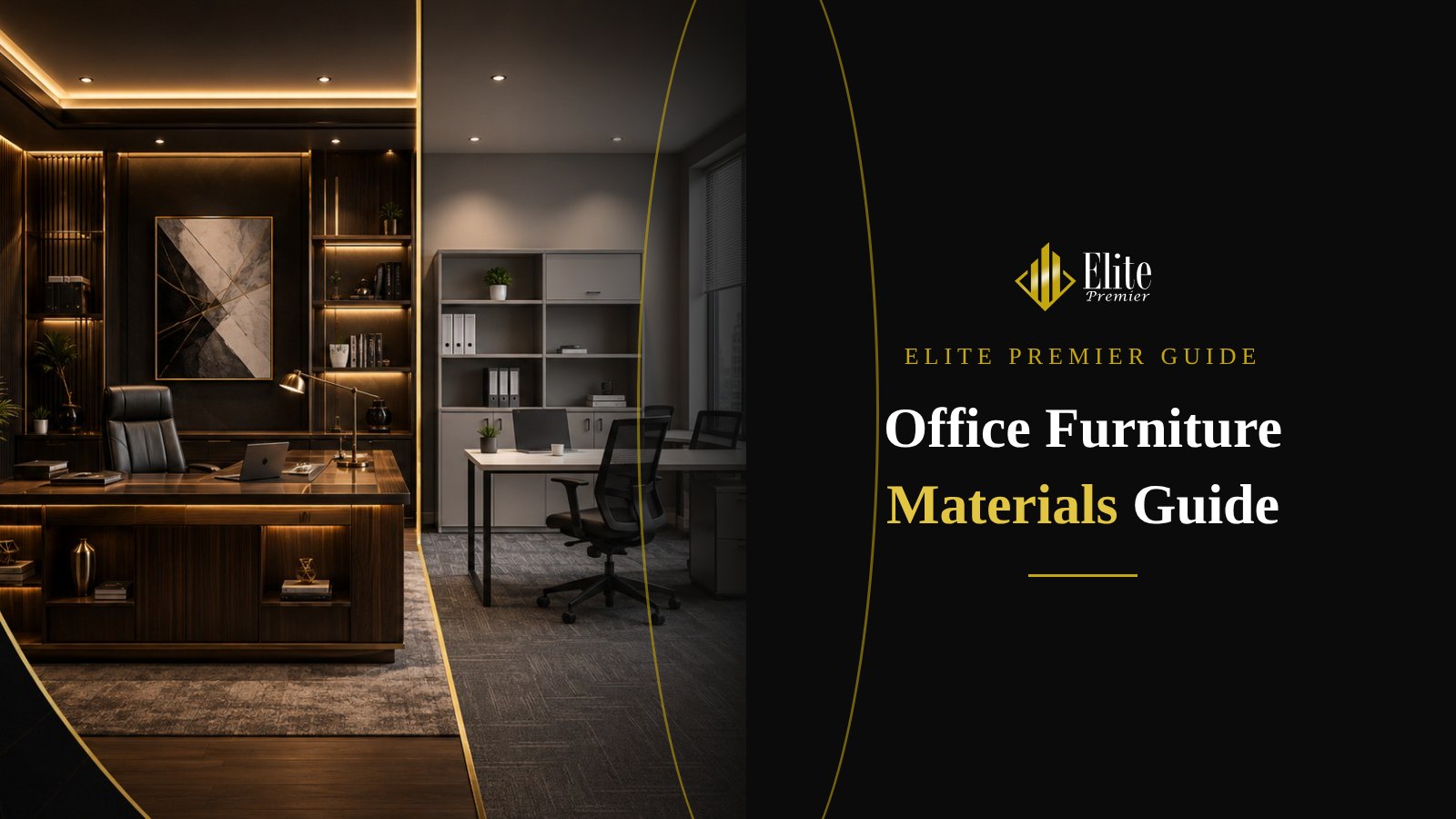
When you request a quotation for office furniture you will see terms such as MDF, HPL, natural veneer, melamine and PVC edging. Often the price gap between two offers comes mainly from these materials, even when the furniture looks similar in pictures. Understanding office furniture materials helps you compare offers fairly, choose the right material for each piece and avoid surprises after a year or two of use. This guide explains the main materials in plain language with a practical comparison and recommendations for every area of the office.
- The difference between engineered boards: MDF, particle board and plywood.
- Surface finishes: melamine, HPL, natural veneer and lacquer.
- When solid wood is worth the higher cost.
- Why edges, hardware and metal frames determine furniture life.
- How to choose the right material for each piece and compare quotations.
Why office furniture materials matter
Office furniture takes heavy daily use: coffee cups placed hundreds of times, drawers opened constantly, laptops and papers dragged across surfaces and chairs knocking edges. Weak materials show this quickly: scratches, swelling at edges, peeling laminate or failing drawers. The right material keeps furniture looking good for years and lowers its real long-term cost.
That does not mean the most expensive material is always best. Premium solid wood may be wrong for a workstation under heavy use, where a durable HPL top is the smarter choice. The key is matching material to function and location, which is why every office furniture execution project we deliver starts by specifying the right material for each element.
Engineered boards: the core of office furniture
Most modern office furniture is built from engineered wood boards with an outer finish. This is not a compromise but the global standard, because these boards are dimensionally stable, do not crack or warp like solid timber and cost less. The main types:
MDF (medium-density fibreboard)
Made from fine wood fibres bonded under heat and pressure. It has a very smooth, uniform surface, ideal for painting, shaping, CNC routing and curved edges, and holds screws and hinges well. Standard grades are sensitive to moisture, so moisture-resistant MDF (often green at the core) is preferred near water or in humid coastal environments.
Particle board (chipboard)
Made from larger wood chips and particles bonded with resin. Lighter and cheaper than MDF and widely used in ready-made and budget furniture, but less tolerant of repeated assembly and more sensitive to moisture at exposed edges. Suits pieces without heavy loads or frequent disassembly.
Plywood
Thin layers of real wood glued in alternating directions. Very strong for its weight and more moisture-tolerant than MDF or particle board, used for load-bearing parts or designs that show its layered edge as a feature.
| Material | Advantages | Drawbacks | Best use |
|---|---|---|---|
| MDF | Smooth surface, great for paint and shaping, holds hardware well | Heavy; standard grade sensitive to moisture | Desk tops, fronts, counters, shaped pieces |
| Moisture-resistant MDF | Better humidity tolerance | Costs more than standard | Pantries, coastal areas, clinics |
| Particle board | Light and economical | Less strength and assembly tolerance | Budget pieces and internal carcasses |
| Plywood | Strong, relatively light, moisture tolerant | Higher cost, less smooth surface | Load-bearing parts and special designs |
| Solid wood | Luxury, long life, can be refinished | High cost, moves with heat and humidity | Executive offices and statement pieces |
Surface finishes: what you see and touch
The board is the structure; the finish determines appearance and resistance to scratches, heat and stains. Much of the difference in quality and price lies here:
Melamine (LPL)
Resin-impregnated paper pressed directly onto the board. Economical, available in many colors and wood patterns and reasonably durable for normal use. Widely used for carcasses, drawers and budget furniture, but less resistant to impact and deep scratches than HPL.
HPL (high-pressure laminate)
Multiple layers of resin-impregnated paper pressed under high heat and pressure into a hard sheet, then bonded to the board. More resistant to scratches, heat, impact and stains than melamine, making it the preferred top for workstations, meeting tables and counters in heavy-use settings such as government offices, clinics and training centres. Matt finishes reduce distracting reflections.
Natural veneer
Thin slices of real wood such as walnut, oak or ash bonded to MDF and sealed with lacquer. It gives the warm, premium look of real wood with the stability of an engineered board and a lower cost than solid wood. Common in executive offices, main meeting rooms and reception. It needs more care than HPL, and the lacquer type (such as PU) determines its scratch and heat resistance.
Lacquer and paint
Painting MDF in matt or gloss layers gives uniform colors and seamless surfaces, ideal for contemporary designs and fronts. Quality multi-coat lacquer lasts well but shows scratches and knocks more on heavy-use tops, so it suits fronts and decorative pieces more than work surfaces.
🟫
Melamine
Economical and colorful, ideal for carcasses and drawers.
⬛
HPL
The toughest choice for heavy-use work surfaces.
🪵
Natural veneer
Real wood luxury at lower cost, for executive offices and boardrooms.
🎨
Lacquer
Uniform colors and smooth surfaces for fronts and modern designs.
Solid wood: when is it worth it?
Solid wood has a charm that cannot be fully imitated: its texture, scent and unique grain make every piece different, and it can be sanded and refinished after years. But it costs much more, moves with temperature and humidity and needs more skill to manufacture.
We recommend it for pieces that deserve the investment: the CEO’s desk, the main boardroom table, a reception counter in a premium headquarters, or details such as edges and bases. For workstations and storage, veneer or HPL is usually smarter.
💡 Elite tip: A smart combination we use often: a boardroom table with a premium veneer top, solid wood edges and a high-quality MDF core. You get the full look of natural wood with better stability and cost.
Edges: the detail that decides furniture life
The edge is the weakest point of any finished board and where damage usually begins. Good specifications define edge type, thickness and bonding:
- 2 mm PVC or ABS edging: the right standard for work surfaces, absorbing knocks and sealing out moisture.
- Thin edging (0.4–1 mm): suitable for internal parts with little impact.
- Machine hot-melt bonding: keeps edges secure over time, unlike manual gluing.
- Rounded edges: safer and more comfortable, especially in clinics and busy spaces.
- Solid wood lipping: used with veneer for a premium look and higher resistance.
Metal frames
Many workstations and meeting tables rely on metal legs and frames. Three things matter: steel thickness to carry loads without wobbling, coating quality (powder coating resists scratches and rust) and a design that routes cables and allows levelling on uneven floors. For sit-stand desks, the frame and motors are the most important components.
Hardware: hinges, runners and locks
Hardware may be small, but it moves the most. A cheap hinge or weak runner can make well-made furniture feel poor within months. Look for:
- Soft-close hinges and runners.
- Full-extension runners rated for the weight of files.
- Central locking for units holding important documents.
- Branded hardware with spare parts available later.
- Comfortable, durable handles that suit the design.
Upholstery and fabrics
For chairs, sofas and waiting seating, fabrics determine much of the comfort, look and lifespan. Contract fabrics are rated for abrasion resistance; the higher the rating, the heavier the use they can take. PU faux leather is a practical, wipe-clean option for waiting areas and clinics, while mesh chair backs give welcome ventilation in a hot climate.
Materials and health: emissions and air quality
Engineered boards contain binders that can release some formaldehyde, which is why emission classes such as E1 and E0 exist to indicate low emission levels. Choosing low-emission boards improves indoor air quality, especially in enclosed, constantly air-conditioned offices. This is part of the sustainability approach described in our sustainable office furniture guide.
Materials in the Saudi climate
The climate in Saudi Arabia adds specific considerations. Coastal cities such as Jeddah are humid for much of the year, making sealed edges and moisture-resistant MDF more important, especially in pantries, hospitality areas and clinics. Offices with large glazed facades expose surfaces to strong sunlight, which can change the color of some veneers and fabrics over time without blinds or UV-resistant lacquer. Moving between outdoor heat and air-conditioned interiors also affects solid wood more than engineered boards. We take these conditions into account when recommending materials for each project.
Quick guide: which material for which piece?
| Piece | Suggested material | Why |
|---|---|---|
| Workstation tops | MDF or quality particle board with HPL and 2 mm edging | Withstands daily use and scratches |
| Executive desk | Natural veneer with PU lacquer and solid wood edges | Warm, premium appearance |
| Meeting table | Veneer or HPL depending on use | Balance of luxury and durability |
| Reception counter | Shaped MDF with lacquer or veneer, HPL or solid-surface top | Distinctive design with a durable work top |
| Storage units | Melamine carcasses with HPL or lacquer fronts | Economical and tidy |
| Clinic furniture | Moisture-resistant MDF with HPL or solid surface | Easy to clean and disinfect |
| Partitions | Fabric-covered absorptive panels or glass | Privacy and better acoustics |
These are general recommendations; the final choice depends on budget, design and use. We provide physical samples of each material before production so you can see and feel the difference. See also clinic furniture for medical environments.
How to compare quotations on materials
When you receive offers from several suppliers, do not compare totals only. Ask each to state:
- Board type and thickness for each piece (MDF, particle board, plywood).
- Finish type (melamine, HPL, veneer, lacquer) and its source.
- Edge type, thickness and bonding method.
- Hardware type and brand.
- Steel thickness and coating for frames.
- Board emission class, if available.
- Warranty period and coverage.
This way you compare like with like and see whether the cheapest offer relies on lower materials. Read how to choose an office furniture company for more selection criteria.
Caring for furniture by material
- HPL and melamine: damp cloth and mild cleaner; avoid abrasives.
- Natural veneer: soft dry or slightly damp cloth, coasters for cups and no long exposure to direct sun.
- Lacquer: gentle cleaning without harsh chemicals.
- Fabrics: regular vacuuming and immediate stain treatment.
- Metal: wipe with a dry cloth and avoid acidic cleaners.
Conclusion: the right material in the right place
No single material is best for everything. Match material to function, location and budget: HPL for heavy-use tops, veneer for executive offices and boardrooms, moisture-resistant MDF in humid areas, with special attention to edges and hardware. Always ask for physical samples before approving.
Want to see and touch the materials before deciding?
We provide physical samples of boards, finishes and fabrics and manufacture your furniture in Jeddah with the right material for each piece.
Frequently asked questions
What is the difference between MDF and solid wood?
MDF is an engineered board of compressed wood fibres, stable, cheaper and ideal for painting and shaping; solid wood is more expensive and premium, moves with heat and humidity but lasts long and can be refinished.
What is HPL and why is it used in offices?
HPL is a high-pressure laminate resistant to scratches, heat and stains, making it ideal for workstation and table tops in heavy-use areas.
Is veneer real wood?
Yes. Veneer is a thin slice of natural wood bonded to MDF, giving a real-wood look with better stability and lower cost than solid wood.
Which material is best for staff desks?
Usually an HPL top on MDF or quality particle board with 2 mm PVC edging, because it withstands daily use and is easy to clean.
Is MDF moisture resistant?
Standard MDF is sensitive to moisture, so moisture-resistant MDF is used near water or in humid areas.
Do you provide material samples before manufacturing?
Yes. We provide samples of boards, finishes, colors and fabrics for approval before production starts in our Jeddah factory.
Related services and guides: office workstations and executive office furniture.